Northern Paiutes of the Malheur: High Desert Reckoning in Oregon Country by David H. Wilson
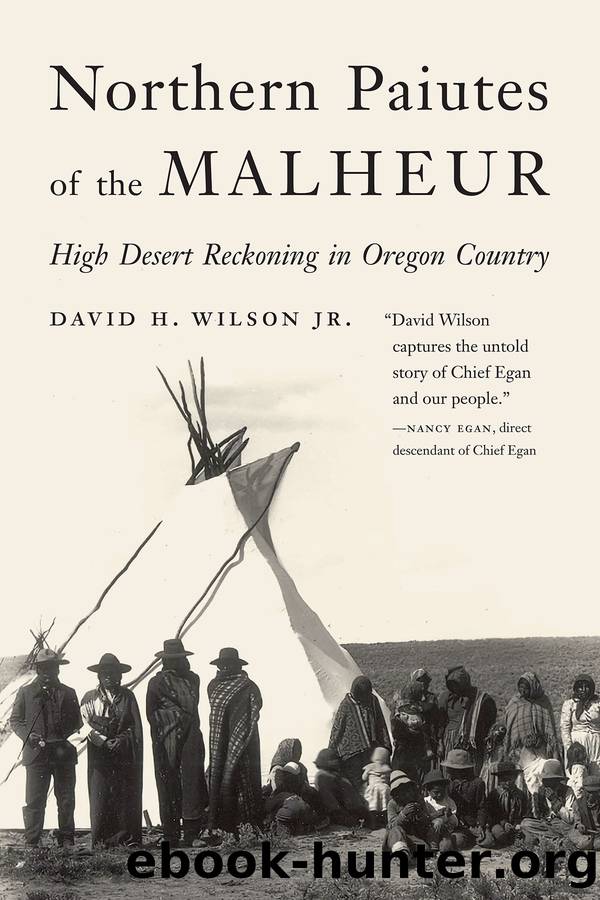
Author:David H. Wilson [Wilson, Jr., David H.]
Language: eng
Format: epub
Tags: History, Indigenous Peoples of the Americas, United States, State & Local, Pacific Northwest (OR; WA), Social Science, Ethnic Studies, American, Native American Studies
ISBN: 9781496230454
Google: BTtjEAAAQBAJ
Publisher: U of Nebraska Press
Published: 2022-05-15T20:43:29+00:00
* * *
Two weeks earlier, after visiting the Birch Creek battlefield, Fitzgerald had written to his wife that he had found a Paiute dress for her, among the other possessions that Paiutes had abandoned in their hasty retreat. Now, after he and Robbins returned from their visit to the last battlefield of the war, he wrote to her again about another relic of the conflict. He explained that he went âabout a mile from camp on an errand for the Medical Museum. Yesterday morning, the Umatillas had a fight with the hostiles and killed 11 of them, one of them being the Piute Chief Egan. Well, I went out and got the latterâs head and was back in camp in less than half an hour.â8 Robbins and Dr. Fitzgerald had found Eganâs body with his arm bound up as a result of the shot fired by Robbins at Silver Creek.9 After removing Eganâs head, Dr. Fitzgerald evidently met with Sarah Winnemucca because she wrote to Natchez: âHis scalp was taken, his deformed hand cut off and his head amputated for identification. Dr. Fitzgerald has the head in spirits.â10 It is likely that Fitzgerald told Sarah that the head was removed for identification, to avoid telling her that the actual reason was to use the skull to demonstrate Indian inferiority and to display it in a museum. If Dr. Fitzgerald put the head in spirits, it was to remove the flesh, not preserve it, for he sent only the skull to the Army Medical Museum.11
There were thirteen Paiute corpses at the site of the shootings. Robbins and Fitzgerald took only one skull and left the remaining dozen. Presumably it was not a matter of chance that the skull taken was that of the only chief among the dead. If the purpose of taking the skull was to compare it with the skulls of whites, why would Eganâs skull be any more significant than the skull of any other Paiute?
Almost four months later Assistant Surgeon V. B. Hubbard went to the site where Egan was killed. Hubbard found Eganâs headless body and, close by, the intact body of Eganâs brother-in-law, Charlie, who had been at Eganâs side at the battle at Silver Creek. Hubbard sawed off Charlieâs head and sent it to the Army Medical Museum.12 (A composite photograph of Charlieâs skull with the skulls of five other Paiutes is in the archives of the Smithsonian Institution and has been intermittently displayed on various websites.)13
The Army Medical Museum was formed in 1862 to collect examples of Civil War battlefield pathology. In 1866 when the museum reopened in a new building, museum leaders feared that visitors would have little interest in the display of body parts ravaged by war. Yet in time it became one of the most popular tourist attractions in the capital, aided by the notoriety of its premises, the former Fordâs Theater, site of Abraham Lincolnâs assassination. Not at all reluctant to exploit the museumâs location at the scene of
Download
This site does not store any files on its server. We only index and link to content provided by other sites. Please contact the content providers to delete copyright contents if any and email us, we'll remove relevant links or contents immediately.
Cecilia; Or, Memoirs of an Heiress — Volume 1 by Fanny Burney(32561)
The Great Music City by Andrea Baker(32021)
Cecilia; Or, Memoirs of an Heiress — Volume 2 by Fanny Burney(31958)
Cecilia; Or, Memoirs of an Heiress — Volume 3 by Fanny Burney(31944)
We're Going to Need More Wine by Gabrielle Union(19051)
All the Missing Girls by Megan Miranda(16042)
Pimp by Iceberg Slim(14517)
For the Love of Europe by Rick Steves(14151)
Bombshells: Glamour Girls of a Lifetime by Sullivan Steve(14079)
Talking to Strangers by Malcolm Gladwell(13375)
Norse Mythology by Gaiman Neil(13372)
Fifty Shades Freed by E L James(13245)
Mindhunter: Inside the FBI's Elite Serial Crime Unit by John E. Douglas & Mark Olshaker(9346)
Crazy Rich Asians by Kevin Kwan(9295)
The Lost Art of Listening by Michael P. Nichols(7507)
Enlightenment Now: The Case for Reason, Science, Humanism, and Progress by Steven Pinker(7315)
The Four Agreements by Don Miguel Ruiz(6767)
Bad Blood by John Carreyrou(6625)
Weapons of Math Destruction by Cathy O'Neil(6283)
